

Melasma Treatment in Dubai & the UAE: Causes & Options
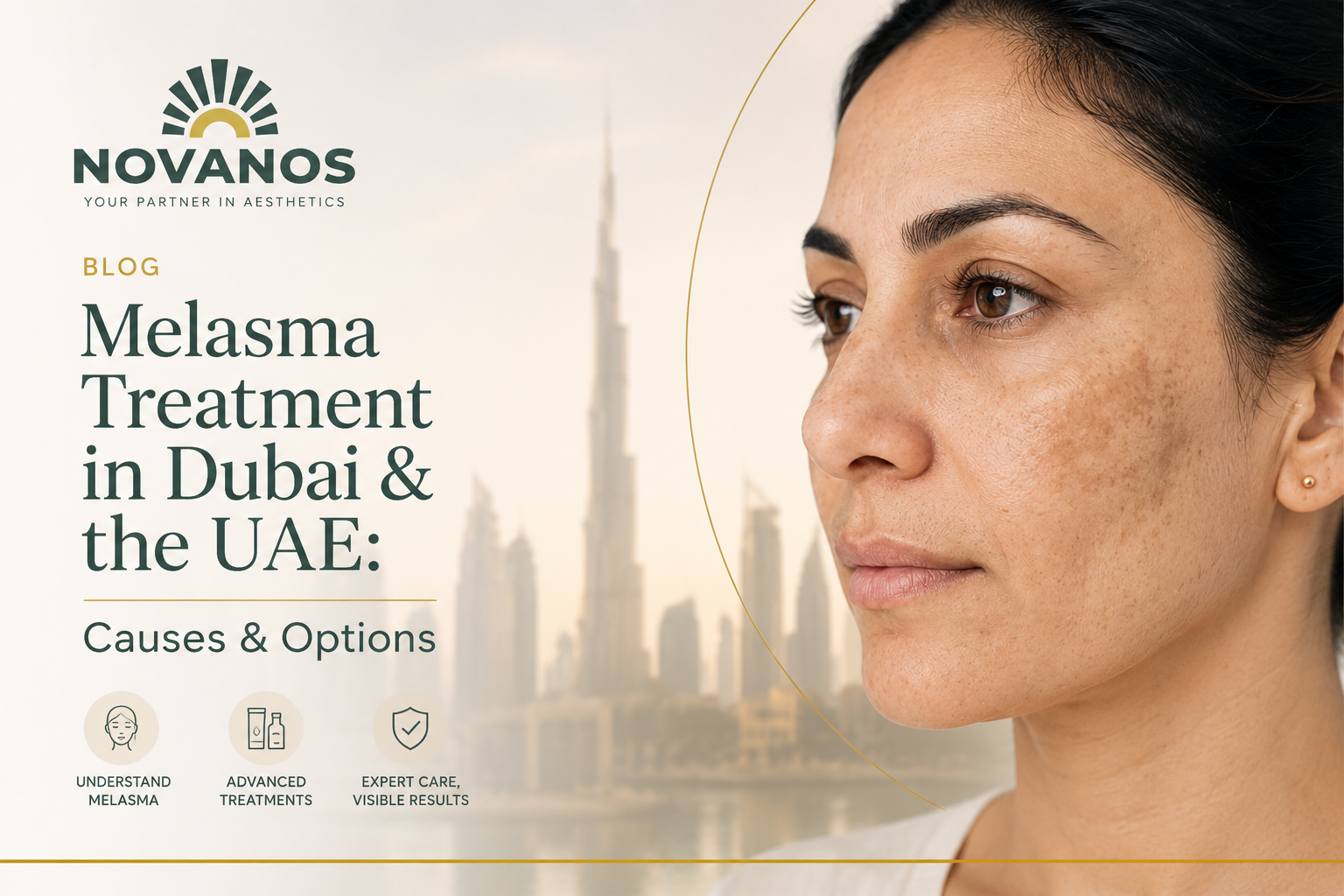
Melasma treatment is one of the more misunderstood corners of aesthetic dermatology, and Dubai clinics see it constantly. It shows up as symmetrical brown or grey-brown patches, usually across the cheeks, upper lip, forehead, and chin, and it’s especially common in the UAE and wider MENA region, where sun exposure is intense year-round and skin types are predominantly Fitzpatrick III–V. Despite how often it’s seen here, melasma is still frequently misdiagnosed and undertreated. This guide covers what actually causes it, how it’s classified, what treatment looks like at each stage, and what it tends to cost locally.
What Is Melasma?
Melasma is a chronic, acquired form of skin hyperpigmentation. It appears as irregular, sharply defined patches of brown or greyish discolouration, most often distributed symmetrically across the face. The cheeks, upper lip, forehead, nose, and chin are the usual sites, though it can occasionally reach the neck and forearms.
At a cellular level, the problem is overactive melanocytes: the pigment-producing cells in the skin’s basal layer. When they’re stimulated too much, they overproduce melanin, which builds up in the epidermis and, in deeper cases, the dermis too. Melasma itself isn’t dangerous. There’s no disease process behind it, but for a lot of patients it carries real psychological weight, simply because it’s so visible.
Types of Melasma
Melasma is classified by how deep the pigment sits:
- Epidermal — pigment in the outermost skin layer, usually well-defined and brown, and the type that responds best to treatment
- Dermal — pigment deeper in the skin, lighter or more blue-grey, with less defined borders, and slower to respond
- Mixed — a combination of both, the most common presentation, usually needing a combined treatment approach
How Melasma Differs From Sunspots and PIH
Melasma isn’t the same thing as a sunspot or post-inflammatory hyperpigmentation (PIH), and getting this distinction right matters before choosing a protocol, since each one behaves differently and responds to different treatments. A dermatologist will usually confirm which one they’re looking at with a Wood’s lamp before recommending anything.
What Causes Melasma?
There’s rarely a single trigger. Most patients have two or three of the following stacking on top of each other.
UV and Visible Light Exposure
UV-A and UV-B radiation stimulate melanocytes directly and switch on tyrosinase, the enzyme that drives melanin production. Visible light matters too — high-energy visible (HEV) light from sun and screens can provoke melasma on its own, and ordinary chemical sunscreens don’t block it. Only tinted mineral sunscreens with iron oxide actually do.
Hormonal Influence
Oestrogen and progesterone stimulate melanocytes directly, which is why melasma is roughly nine times more common in women than men and why it so often appears or worsens during pregnancy (sometimes called chloasma), on the contraceptive pill, or during hormone replacement therapy. In some women it lingers well after the hormonal trigger is gone.
Genetic Predisposition
Somewhere between 40 and 50% of melasma patients have a family history of it. Fitzpatrick skin types III–V are considerably more prone to it, which is exactly why it’s such a common presenting concern in Middle Eastern, South Asian, and Latin populations.
Heat and Infrared Exposure
There’s growing evidence that thermal energy alone — independent of UV — can stimulate melanocyte activity. Patients being actively treated are usually advised to go easy on saunas, hot yoga, and cooking over an open flame.
Thyroid Dysfunction
A few studies have linked hypothyroidism to melasma, which is one reason practitioners sometimes screen for thyroid issues in patients whose melasma won’t respond to standard protocols.
Who Is Most at Risk in the UAE and MENA Region?
Melasma affects women in more than 90% of cases, usually between the ages of 20 and 50, though men aren’t immune. Risk climbs with:
- Fitzpatrick skin types III–V (olive to darker tones)
- Pregnancy, oral contraceptive use, or hormone replacement therapy
- A family history of melasma
- High, near-constant UV exposure — which describes most of the year in the Gulf
- Thyroid disorders
- Middle Eastern, South Asian, East Asian, or Latin ancestry
In the UAE specifically, melasma sits among the top three pigmentation concerns seen in dermatology and aesthetic clinics — a combination of the region’s UV index, genetic predisposition, and widespread hormonal contraceptive use.
How Is Melasma Diagnosed?
Diagnosis is mostly clinical: a visual exam, backed up by a Wood’s lamp to work out how deep the pigment sits. A thorough consultation should cover:
- How long the pigmentation has been there and how it’s progressed
- Hormonal history: contraception, pregnancy, HRT
- Sun exposure habits and current sun protection routine
- Previous treatments tried and how they went
- Family history and Fitzpatrick skin type
- Any thyroid symptoms
Dermoscopy can add detail by revealing pigment patterns beneath the surface. A biopsy is rarely needed unless something else — Hori’s naevus or exogenous ochronosis, for instance — is suspected instead.
Melasma Treatment Options: Topical, Procedural, and Injectable
There’s no single treatment that clears melasma completely or permanently. Nearly every effective protocol combines more than one of these:
- Photoprotection (the non-negotiable baseline)
- Topical depigmenting agents
- Procedural treatments — peels, microneedling, laser
- Injectable brightening protocols
Photoprotection
This isn’t optional. It’s the foundation everything else sits on, and broad-spectrum SPF 50+ covering UVA, UVB, and HEV (visible light) is non-negotiable. Without it, every other treatment underperforms. Tinted mineral sunscreens with iron oxide are the only formulation that actually blocks visible light, which matters more in the Gulf’s light conditions than almost anywhere else.
Topical Depigmenting Agents
Hydroquinone (2–4%) is still the reference standard, though long-term use raises legitimate concerns about ochronosis, and combining it with tretinoin and a topical steroid (the Kligman-Willis formula) generally outperforms any single agent alone. For patients who’d rather avoid hydroquinone, kojic acid, tranexamic acid, niacinamide, and azelaic acid all have reasonable evidence behind them.
Procedural Treatments — Peels, Microneedling, Laser
Chemical peels (glycolic, mandelic, trichloroacetic), microneedling, and low-fluence laser (Q-switched Nd:YAG or pico) can speed things along, but they carry a real risk of triggering post-inflammatory hyperpigmentation, especially on darker skin. These need a cautious hand and a solid pre- and post-treatment depigmenting protocol around them, not a stand-alone fix.
Injectable Brightening Protocols
Injectable mesotherapy aimed at melanogenesis works differently from either of the above. Where topical agents are limited by how far they can penetrate the epidermis, an injectable delivers active ingredients straight to where the melanocyte activity is actually happening, which matters most for dermal and mixed melasma, where topical-only approaches tend to underperform.
What Does Melasma Treatment Cost in Dubai & the UAE?
Cost varies a lot depending on the modality, how many sessions are needed, and which clinic tier is involved. Laser and IPL sessions in Dubai typically run into the hundreds of AED per visit, with a full course requiring several sessions over weeks or months. Injectable mesotherapy protocols are usually priced per session too, and most patients need a series rather than a single visit, since melasma responds gradually rather than all at once.
A few things drive the price more than people expect: the number of sessions (severity and skin type both affect this), whether the clinic combines modalities — an injectable protocol alongside maintenance topicals, say — and the practitioner’s experience level, which matters a great deal for a condition where the wrong treatment can trigger worse pigmentation. Because Allier Paris supplies treatment protocols through authorised clinics rather than selling direct to patients, pricing is set locally by the treating clinic. Patients should get a quote directly from their practitioner, and practitioners looking to offer an Allier Paris protocol can find an authorised Allier Paris clinic partner or reach the regional team directly.
MELASMA BRIGHT by Allier Paris: Mechanism and Clinical Application
MELASMA BRIGHT is Allier Paris’s professional-grade injectable, formulated specifically for melasma and diffuse hyperpigmentation, and built on the same peptide science behind Allier Paris’s wider product line. It works at three points in the melanin pathway: inhibiting tyrosinase, the enzyme that starts melanin production; calming overstimulated melanocytes; and acting on existing pigment deposits to fade patches that are already there while limiting new ones from forming.
Recommended clinical use:
- Indicated for epidermal, mixed, and moderate dermal melasma
- Formulated for Fitzpatrick III–VI, where laser carries more risk
- Protocol set in consultation with an Allier Paris distributor or regional representative
- Typically paired with daily SPF 50+, topical maintenance, and GENOWHITE or INSTANT GLOW for a combined effect
- Available exclusively through authorised aesthetic clinics and the distributor network — professional use only
MELASMA BRIGHT is available strictly for use by qualified aesthetic practitioners and dermatologists. Clinics in the UAE can contact their Allier Paris regional representative for protocol details and access.
Melasma and Pregnancy: What to Know Before Treatment
Pregnancy-related melasma, sometimes called chloasma or the “mask of pregnancy,” is one of the most common questions patients bring to a first consultation. It deserves a direct answer, not a footnote under hormonal causes.
Rising oestrogen and progesterone during pregnancy stimulate melanocyte activity, and combined with sun exposure, that’s usually enough to trigger new pigmentation or darken existing patches. It typically appears in the second or third trimester and, for a meaningful share of women, fades on its own within a year of delivery, though it can persist, particularly with continued sun exposure or a return to hormonal contraception afterward.
Treatment during pregnancy is deliberately conservative. Hydroquinone, retinoids, and most procedural treatments (peels, laser, microneedling) aren’t recommended while pregnant or breastfeeding, since safety data is limited and the risk isn’t worth taking for a condition that’s cosmetic rather than medical. Daily broad-spectrum SPF with visible-light protection is the one intervention that’s both safe and genuinely effective at limiting how much pigmentation develops in the first place. Any active treatment, injectable or otherwise, should wait until after pregnancy and breastfeeding, and should always be discussed with an obstetrician as well as the treating practitioner.
How to Prevent Melasma From Returning
Melasma has a high recurrence rate even after a good response to treatment. Sun exposure or a hormonal shift is often enough to bring it back. Long-term management is about prevention, not just correction:
- Daily broad-spectrum SPF 50+ with visible-light protection, reapplied every two hours outdoors
- Avoiding peak UV hours (10am–4pm) and wearing a wide-brimmed hat when that’s not possible
- Reviewing hormonal contraception with a doctor if melasma is clearly hormone-driven and keeps coming back
- A low-dose maintenance topical (kojic acid, azelaic acid, or niacinamide) two to three nights a week
- An annual skin-type and pigment-depth reassessment with a practitioner
- Limiting sauna use, prolonged heat exposure, and cooking over direct heat during active treatment
Frequently Asked Questions
Q: Is Melasma Permanent?
It’s chronic, but not permanent in the sense of being untreatable. Photoprotection, topical agents, and injectable protocols achieve meaningful lightening in most patients. Complete, permanent removal is rare, and ongoing maintenance is usually needed to keep it from coming back.
Q: Can Men Get Melasma?
Yes, though it’s far less common — around 10% of cases. Treatment is the same, but male patients often have more occupational or lifestyle sun exposure, which is worth addressing directly in the management plan.
Q: How Long Does Melasma Treatment Take to Show Results?
Topical agents typically show visible improvement at 6–8 weeks, with more meaningful change by 3–6 months of consistent use. Injectable protocols like MELASMA BRIGHT can move faster; many patients notice clearer skin within 2–4 weeks. Results still depend on pigment depth, skin type, and how consistently sun protection is followed.
Q: Is It Safe to Treat Melasma on Darker Skin Tones?
Yes, with the right product choice. Fitzpatrick IV–VI skin carries a higher risk of post-inflammatory hyperpigmentation from aggressive peels or laser. Injectable mesotherapy is generally well tolerated across skin tones and is often the safer first-line option for darker skin. A practitioner should confirm Fitzpatrick type before starting anything.
Q: What Does Melasma Treatment Cost in Dubai?
It depends heavily on modality and session count. Laser and IPL are usually priced per session, and injectable protocols follow a similar model, with most patients needing a series rather than one visit. Ask the treating clinic for a quote based on your specific case; pricing isn’t standardised across the UAE.
Q: Can Melasma Be Treated During Pregnancy?
Only conservatively. Daily SPF with visible-light protection is safe and effective at limiting new pigmentation. Hydroquinone, retinoids, peels, and laser aren’t recommended during pregnancy or breastfeeding. Active treatment should wait until afterward, in consultation with both an obstetrician and the treating practitioner.
Q: Can Melasma Come Back After Treatment?
Yes, relapse is common, especially with sun exposure or hormonal changes. That’s why ongoing sun protection and a maintenance topical routine are treated as part of the protocol, not an afterthought. A practitioner may also recommend periodic maintenance sessions.